
Computer Generated Text

There is a whole creative field out there that is quite niche but seems to be gaining interest in light of the current developments with autonomous agents. It concerns text and computation, and scholars call it computational literature or computational literary studies. Over the past two years, I’ve been slowly dipping into the field, learning about the who and what and beginning to shape ideas on the ultimate why too. At a time when machines are capable of generating text that is as convincing in its content and meaning as it is problematic in its provenance and status, many complex questions have come to the fore. My understanding of these is small, but I feel compelled to structure some ideas in writing here and share with you some recent work.
Roughly two years ago now, I started to compile a small set of computer functions that can manipulate text. These were relatively humble operations for cutting up text, sampling letters, words, rearranging them, and replacing them. The main goal was to use these in a short course with my graphic design students and propose that they work on text as a subject at large but with some use of the computer and programming. Two main questions drove my interest and became the underlying thread for that work: Firstly, if text can be computed, then what kind of computations are possible? Secondly, what meaningful patterns arise from these? The first iteration of that course was well received, and the students proposed some fascinating ideas. Encouraged by this, the small set of functions grew, and I began to work on a personal set of protocols to explore further these two questions. I’m currently developing this framework with the intention of publishing as well as exhibiting work in the future. I also pursued with the course this year, and I hope to share some of my student’s productions soon.
It is precisely this hands-on relationship with code and language that has sharpened my unease about what autonomous agents are doing to both. I maintain a healthy scepticism towards these so-called tools. I say healthy because I use them myself, partly to get things done like us all, yet mostly to learn more about their workings and the kind of effects it may be having on me as my students. I’m aware of my limits with regard to use and I remain very conscious of the broader implications that using these tools may have on our societies and ecologies at large. One of the main issues that really interests me is how these technologies are displacing the role of the author/creator.
How much of the process are you willing to give up to the machine and how much credit do you give it in the final work? Working with computer code and generative practices since the late 2000s, these were questions that I was fully aware of but never really gave much thought. For me, the writing of code to generate artistic production was an equal part of that creative process. The fact that I was engaged and implicated in the writing of that code was testament to my role. However, with the arrival of autonomous agents, those questions have become ever-present again.
Going back to the framework I’ve been developing lately to explore text and computation, it should be pointed out that I’ve not yet implemented any Large Language Models. While I acknowledge a variety of artists, poets, and researchers working with their own language models, I’m intentionally limiting my own work to traditional programmatic practices in generating texts. There is a rich, albeit small, history of computer-generated texts demonstrating innumerable ways in which to engage with language using a purely programmatic approach. This, along with my work with my students, is my current guide to learning more skills as a programmer and directly influencing my work as a poet, author, and artist. In a time when the question of who or what makes a text has never been more fraught, I find that working slowly, programmatically, and by hand remains my clearest way of thinking it through.
Some recent finds that have inspired this brief text.
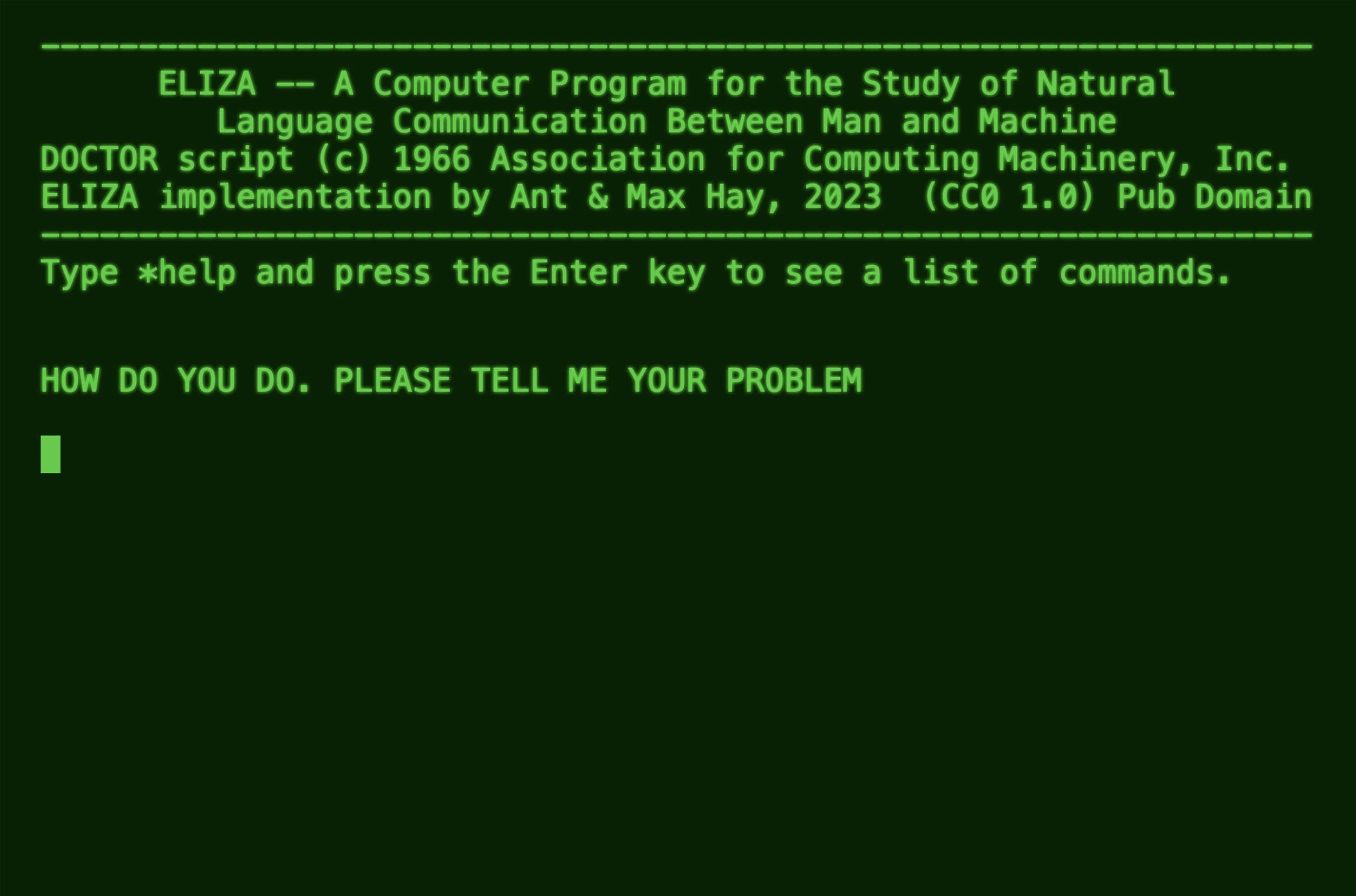
Inventing Eliza. How the First Chatbot Shaped the Future of AI.
Eliza Archaelogy. A gem of a website sharing research for the above book.