
An Illusion Pristine
Part of the Tyranny of Type series

The pervasive introduction and growing use of large language models presents a rupture in language of a particular order. A rupture led by aggressively imposing tools and platforms that swarm the masses. Their speed of arrival has given us little time to question them, adapt to them, nor really understand them. As someone who engages with language and especially text, I find myself constantly battling to find some sort of resolve with regards to this plight. A moderate resistance has been my only strategy. Recently, however, certain questions have come to the fore in line with my practice and general thinking about this particular invasion: If text can be automated with seamless, coherent, and meaningful charm, then what is left of the presence of the voice, the author, and the authenticity of our human experiences expressed through the written word?
Writing is a technology that has undergone a number of major revolutions from its beginnings as a mark-making tool for early commerce and agriculture. The multitude of ingenious scripts from the Sumerians, the Egyptians, to the Chinese and the Mayans, through to the dominant alphabets of the world, are testimony to a long, rich, and entangled history. We could take a deep look at that initial part of writing history. Look at the who and the why, the tools, techniques, and technologies that have slowly become an integral part of what we call today a literate culture. However, a myth is a far more enticing read, is it not? So, let us start where writing got a serious makeover and point out a contemporary take amid the AI enthusiasts who seek solace in a technological past as a means to validate a certain position of power.
One of the many arguments for encouraging the adoption of LLMs as a writing tool uses the analogy of the Gutenberg press. Indeed, the modern take pitches LLMs as a language revolution on a par with the press and all that ensued. From the democratisation and mass distribution of knowledge to its claim as the instigator of numerous revolutions. That comparative claim makes for sensational reading. Not much else. When you pick beyond the surface a little, some facts demonstrate a very different reality and reveal something more subtle and pertinent about the true characteristics of LLMs and indeed human writing itself.
Gutenberg’s invention facilitated the mass production of texts. Now, in contemporary parlance, you may hear of the press ‘automating’ the production of text and for this reason, there is a tendency to make the direct analogy with today’s machines doing a similar operation. At this point other ideas get dragged into the narrative, comparing the death of authors with the demise of the scribe and introducing complex concepts such as authorship, copyright, and authenticity. As the myth goes, Gutenberg had instigated the erosion of the hand, the gesture, and the embodied thought structures of the written word. Next came the typewriter, the computer, and the word processor, and this neatly culminates in the arrival of LLMs. We could, as so many are already doing, conclude that writing has found its ultimate and logical demise. But that narrative is wrong.
The true fact of the effects of the Gutenberg invention was that it catalysed a series of cultural revolutions — Renaissance, Reformation, Scientific, Enlightenment — with the dissemination of the written word. And through these various mouvements, slow changes took place with people who were given access to texts and consequently a literate society began to develop, albeit small and privileged. Questions relating to authorship, authority and even copyright were never really an issue. Indeed, the concept of an author beyond the Classics and as we understand it in the modern world, didn’t really have weight until the Venetians took to the press and Alde Manuce & Pietro Bembo gave us the first libretto da mano.
While the press has mediated text over the centuries through mechanical means, the imposition of LLMs is doing something completely different. It literally removes the author and hence any authenticity of text and perhaps more bluntly, it removes writing completely. In fact, there is no trace of writing beyond the rather banal argument that the model generates text from human text as a data source. For some AI evangelists, that is all we humans seem to be doing too — cutting and pasting from the dictionaries of our languages just like a machine. Which is a silly assumption.
Another point to mention here is that the Gutenberg press didn’t change the nature of text beyond its formal qualities. Metal type may have diminished the role of the scribe and we could say it also distanced the act of writing that is often so quaintly associated with that endeavour. However, and most importantly, the provenance of the original was always with the written act. The press made for greater distribution of text, but it never obfuscated writing as an activity that is fundamentally tied with the initial act of someone, somewhere, putting thoughts to paper. And why is that important? Because writing is intrinsically linked with a human act.
Writing is predominantly a human endeavour for expressing and recording thoughts. (Note, I’m not using the term encoding that is so often used here. It is not the correct term in my opinion. It reinforces a machinic, binary mechanism, and eschews all the complexity that logic seeks to reduce.) Writing is a means for thinking. (Ong, Goody, Ingold & Postman et al.) It aids in the construction of complex thought and in the structuring of ideas. It is a cool technology for meditation, not a hot bath of running water ad infinitum. Writing is a space for abstracting out ideas and fixing them to a medium that can be shared, read, analysed, criticised, and all with proof of provenance. A text can be held accountable by someone or somebodies. And when you read a text, you are a witness in part to what that person or those people are expressing.
So, are LLMs writing? Well, to put it bluntly, I don’t think they are. There has been no writing in their production. There is no author, authority, no voice behind the words we read. As a counterargument, some may ask, “Is it necessary for writing to have taken place?” Well, LLMs have an interesting role to play, no doubt, in a human process of writing. They can be meaningful sparring partners and a reasonable way to search for and research subjects as long as sources are checked. The crucial point I’m making here has little to do with whether this technology is meaningful or useful. I’m pointing out a subtle yet crucial difference that we don’t really acknowledge because the illusion of text is so pristine. It is about the human presence, authorship, and the accountability for texts that are written. An activity that has gone through that messy process of human thinking, selecting, editing, structuring and the making of choices. In short, texts have authors.
While the Internet fills up exponentially with bot-enthused enshittification, feeding back into the loop that very same generative content, it will become increasingly important for us to account for that content. Some are happy to let that happen. I call them the Singularity Simulators. They are the driving force behind the tech that is engineered to surreptitiously yet aggressively implant long-term goals that pave the way for Silicon Valley’s hidden agenda.
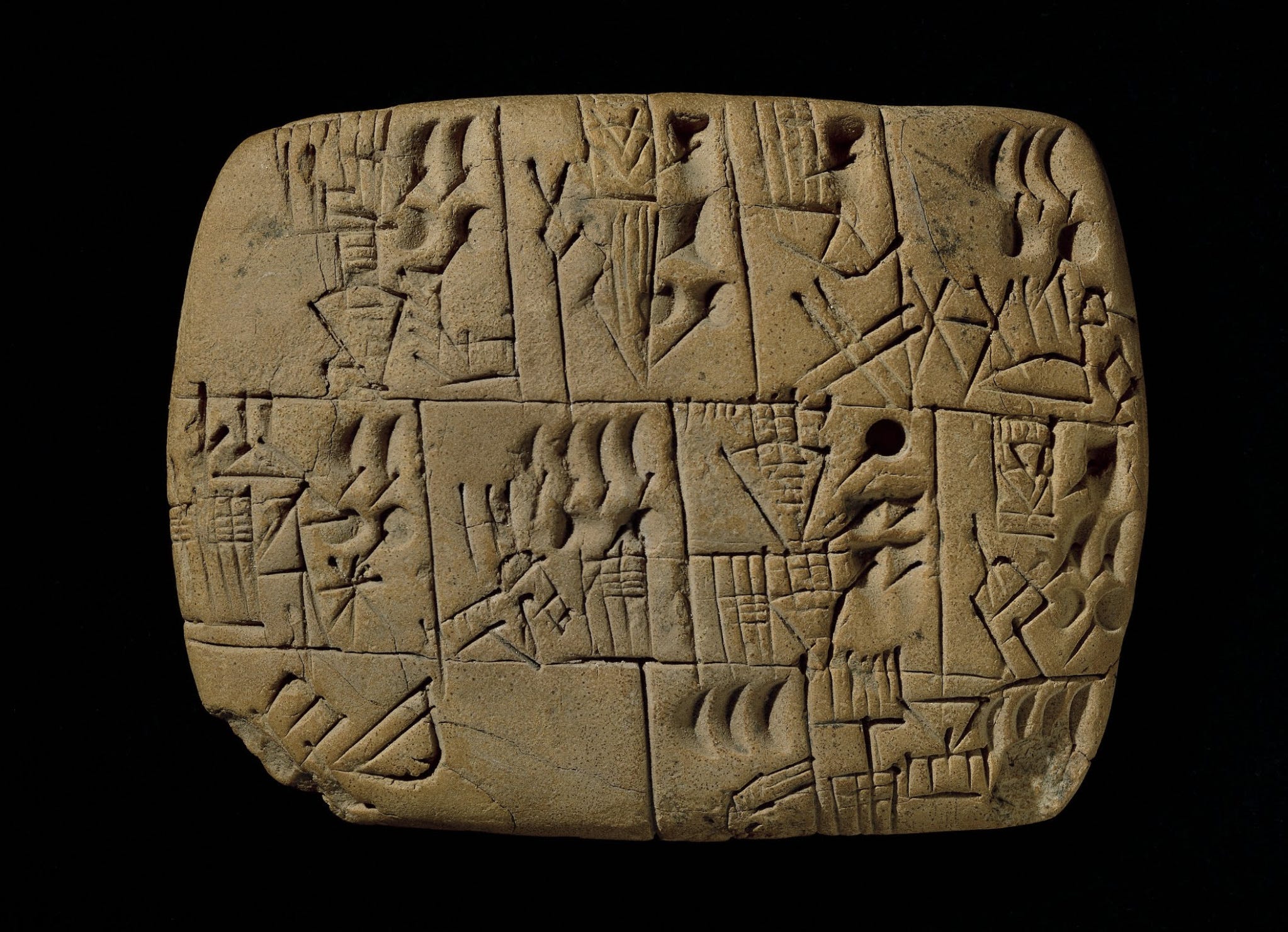
Personally, I prefer the meaning attached to a Sumerian tablet from 3100 BC and realise that this was once a human endeavour that is intrinsically entwined with our human histories. The fact that our societies, culturally, politically, economically and socially are constructed and continue to evolve based on our languages and specifically on our written languages, raises bigger questions about the role we adopt with the machines. That is a far bigger debate. Could it start by at least looking at what is essential - being human?
Reading
A History of Writing. Steven Roger Fischer
Lines. A Brief History. Tim Ingold
De la bêtise artificielle. Anne Alombert
Qu’est-ce que lire? José Ortega y Gasset
The city that lanched the publishing industry. BBC
De Aetna Dialogue. Pietro Bembo
Promenade aux Pays de l’écriture. Armando Petrucci
The dawn of the post-literate society. James Marriott
Medium Hot. Hito Steyerl
Post Scriptum
I observe quite a pushback with regards to AI in recent times. I also read that resistance is a futile battle. I clearly stand amongst the resistance and yet I want to be able to adapt to these changes without being thrown into the Luddite clan of past. AI has a lot to offer us. The above piece of writing may well be of little importance but it did actually help me to clear some complex thoughts that have been rushing through my head for a good while now. I’m sharing because it may be of interest to others. I’m a firm believer in the sharing of ideas. I have faith in humanity.
Thanks Mark, for opening this debate. I could feel from your words that you are not a bot :)
But seriously, I think AI truly helps shortening the process of cultivating information (like you mentioned yourself), but IMO what makes a great writer is their unique voice and tone. At the moment at least, this isn't replaceable. You can smell a text written solely by AI from a distance. Loved what you said about AI not being an author. Cheers!